

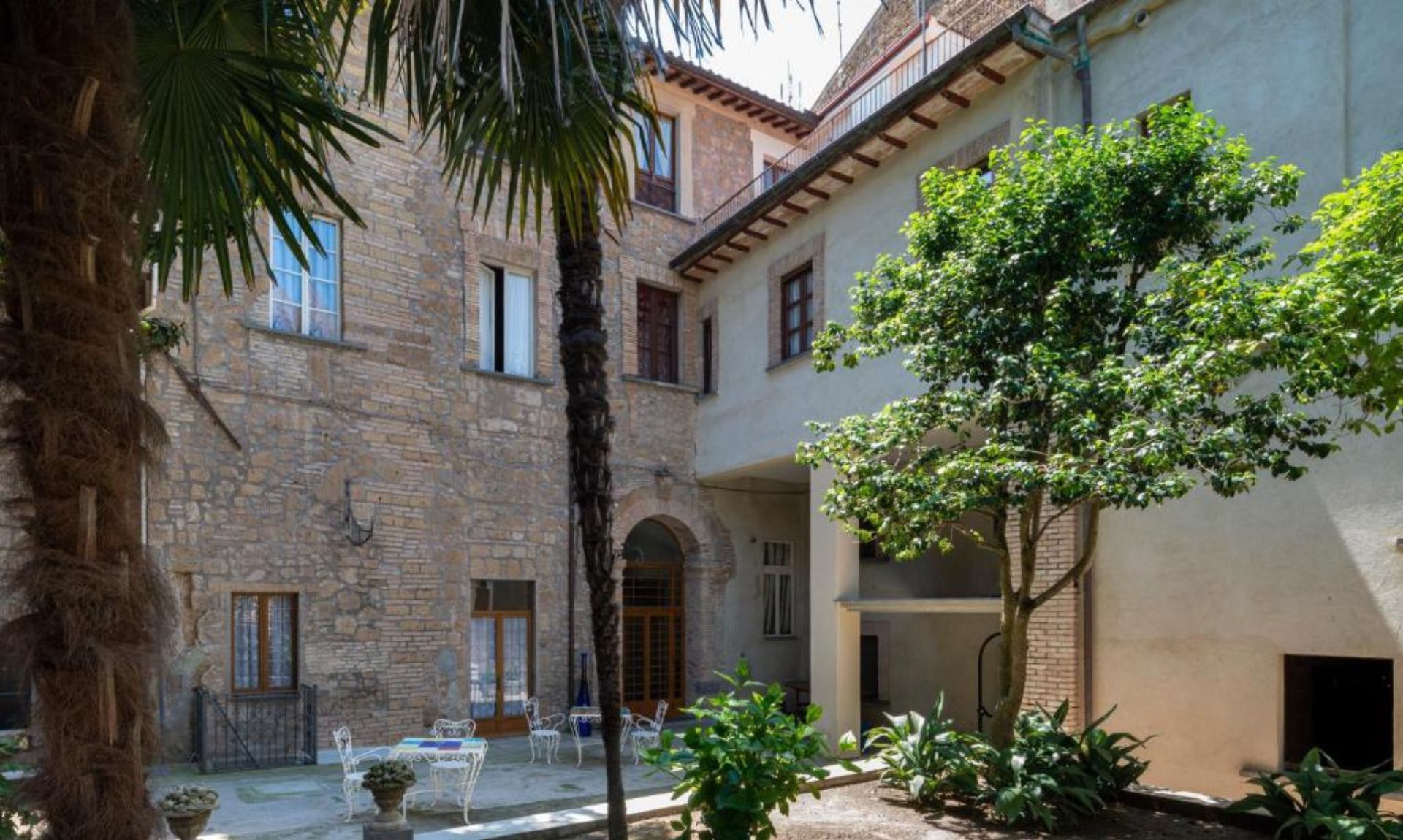
There are buildings that have a history and buildings that are made of history. Palazzo Guidoni belongs to the second category.
We are in the centre of Orvieto, two hundred metres from the Duomo, on one of the streets that cross the medieval heart of the city. From the outside, the stone façade makes no attempt to impose itself: it is sober, composed, in the way that Italian noble palazzos can be when they have no need to announce themselves. The architecture speaks to those who know how to listen.
A sixteenth-century palazzo
Palazzo Guidoni was built in the sixteenth century, during a period when Orvieto was already a city of significance — a papal seat, a crossroads of trade, a place of art and power. The noble families of the time built with the intention of lasting: thick stones, inner courtyards, calculated proportions. Not homes, but statements.
The Guidoni family was one of those families. The palazzo still bears their name, and still bears, in its structures, the marks of that permanence: the ceilings, the corridors, the logic of spaces that follow a hierarchy different from the contemporary one.
The transformation into a hotel
The building became a hotel as far back as the nineteenth century — an ancient transition, not a recent one. This means the transformation is not a modern conversion, not a “historic palazzo restored as a boutique hotel” as there are many today, with everything that formula brings with it: design that overwhelms history, aesthetics that erase character.
Here it is different. Those who took over the property chose a precise direction: to renew without betraying. The spaces have been updated with an essential contemporary style — what is needed to be comfortable today — but the palazzo remains recognisable. The stone is still the same. The corridors still have that width. The inner garden, with its centuries-old plants, is still there.
What it means to sleep in a place like this
It is not a question of luxury. It is a question of layering.
When you sleep in a modern hotel — any modern hotel, in any city — you are in a place designed to be neutral, interchangeable, efficient. There is nothing wrong with this. But there is nothing memorable about it either.
Palazzo Guidoni has a memory of its own. The walls have a thickness you can feel. The rooms have a scale that is not that of standardised contemporary comfort. Walking out in the morning to find yourself already inside the historic centre of Orvieto — two hundred metres from the Duomo, a hundred from the Torre del Moro — is an experience you cannot buy with an upgrade.
It is a choice. Either you choose a place that has a history, or you choose a place that has a swimming pool. Both are legitimate choices. But they are different choices.
Orvieto, and the sense of being at the centre
There is something else that Palazzo Guidoni offers, and it goes beyond the building itself: the location.
Orvieto is a city better understood if you inhabit it, even just for one night, from the inside. Not from the outskirts, not from a hotel outside the walls. From the centre. From the point where the city closes in around you, where the sounds change, where the morning has a different quality.
From here you step out on foot and you are immediately inside the real city: not the city of organised tours, but that of residents, markets, bars where you drink your coffee standing at the counter.
Sleeping in Palazzo Guidoni is not sleeping in a historic hotel. It is sleeping in Orvieto.