

The Park of the Monsters in Bomarzo: What to See and How to Visit
Among the most fascinating places to see near Orvieto is, without doubt, the Park of the Monsters in Bomarzo, also known as the Sacred Grove (Sacro Bosco). Set in the Tuscia area of the Viterbo province, in the heart of a landscape of hills and woods that is itself worth the trip, it is a place quite unlike any other. This is no ordinary park, but a surreal and unsettling journey into the Mannerist art of the sixteenth century.
Unlike the traditional gardens of the age, defined by perfect geometry and rigorous symmetry, the Park of the Monsters surprises the visitor with a path immersed in nature, peopled by giant sculptures carved from stone. Monsters, mythological creatures, fantastical animals and enigmatic figures emerge from the green of the wood, creating an atmosphere that is evocative and out of time.
To follow the park’s paths is to lose yourself in a labyrinth of symbols that, over the centuries, have intrigued and captivated scholars, artists and travellers. Salvador Dalí was so struck by it that he called it a unique historical invention; the director Michelangelo Antonioni devoted the short film La Villa dei Mostri to it; John Shearman cited it more than once in his celebrated study Mannerism; and Alberto Moravia nicknamed it a “stone amusement park” — to name only a few.
Even today the park’s symbolic meaning remains partly mysterious and open to interpretation. Every statue, every inscription, seems to want to tell a story, to reveal a secret, yet without ever offering a single key. It is an experience that defies logic and stirs the imagination — an invitation to lose yourself in order to find yourself again.
A Little History
The park was created in the mid-sixteenth century at the wish of Prince Pier Francesco Orsini, known as Vicino, in memory of his beloved wife Giulia Farnese, who died before her time. His intention was most likely to turn his mind from the pain of loss, a release for a soul at odds with its own torments — “sol per sfogare il core” (“only to unburden the heart”), as one of the garden’s stones reads.
For the design, Vicino turned to the architect Pirro Ligorio, the same who had worked on the prestigious Villa d’Este in Tivoli and who would later, if only briefly, succeed Michelangelo Buonarroti in directing the works of St. Peter’s Basilica.
After Prince Orsini’s death in 1585, the park passed through the hands of various owners — among them the Borghese, the Della Rovere and the Poniatowski families — before being abandoned and swallowed by the vegetation. It was only in the second half of the twentieth century that it was rediscovered and restored by the intellectuals Giancarlo and Tina Bettini, who grasped its priceless value and gave it back to the world.
What to See
Among the many sculptures that populate the Park of the Monsters in Bomarzo, here are some of the most striking you’ll encounter along the way.
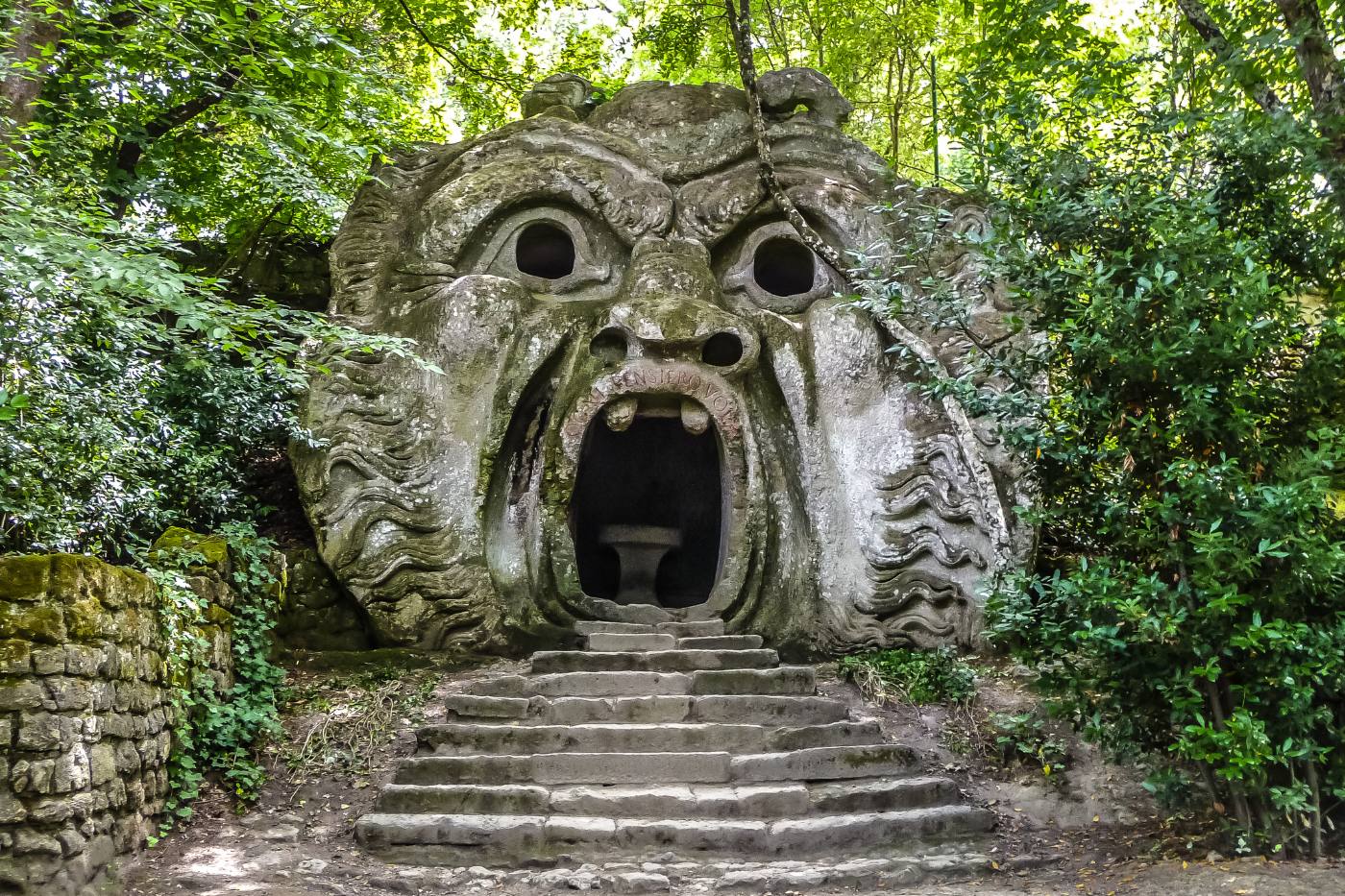
The Ogre
The park’s undisputed symbol, it depicts a giant, monstrous head with its mouth flung wide, which you can step inside. It is thought to have been a place of meditation and withdrawal, as the inscription on its lips suggests — “ogni pensiero vola” (“every thought flies away”) — inviting an experience of meditation and detachment from reality.
The Leaning House
A small building raised on a tilted boulder and therefore deliberately off-kilter. Stepping inside brings a strong sense of disorientation that puts your balance and your perception of space to the test.
Hercules and Cacus
Also known as “the Colossus,” this is the largest sculpture in the park. It portrays two giants locked in combat, identified as Hercules and Cacus, caught at the height of their struggle. The work echoes one of the recurring themes throughout the garden: the fight of good against evil.
The Elephant
A majestic elephant in battle array, crowned by a great tower, grips a Roman legionary in its trunk. It is most likely a tribute to the exploits of Hannibal and the battles the Carthaginians fought against Rome.
The Temple
Built twenty years after the rest of the park, in honour of Vicino Orsini’s second wife, it draws on the architectural forms of the classical and Renaissance ages. Its dome is modelled on that of Santa Maria del Fiore in Florence.
Practical Information for Your Visit
The Park of the Monsters in Bomarzo is easily reached from Orvieto in about 40 minutes.
The visit takes place entirely outdoors, along paths set among the greenery, and is suited to adults and families with children alike. The route poses no particular difficulty, though some stretches may be a little uneven.
The park is open every day of the year except 25 December, with continuous hours. From March to September it opens from 9:00 to 19:00, and from October to February from 9:00 to 17:00.
The best time to visit is spring, when the wood fills with colour and scent, or autumn, a particularly evocative season thanks to the tones of the foliage.
An Experience Not to Miss During Your Stay in Orvieto
The Park of the Monsters in Bomarzo is a place that surprises visitors of every age. The suspended atmosphere, the sculptures emerging from the wood, the silence: it’s a visit that stays with you, unlike any other in the area.
It’s also the kind of place best appreciated when you’re in no hurry. Choosing a hotel in Orvieto in the historic centre means exactly this: setting off in the morning without watching the clock and walking home in the evening, once the coaches have left and the town returns to those who sleep there.
At the Hotel Posta, inside the sixteenth-century Palazzo Guidoni two hundred metres from the Duomo, Bomarzo is just one of many possibilities: the land around Orvieto is best discovered when you have a place to come back to.