

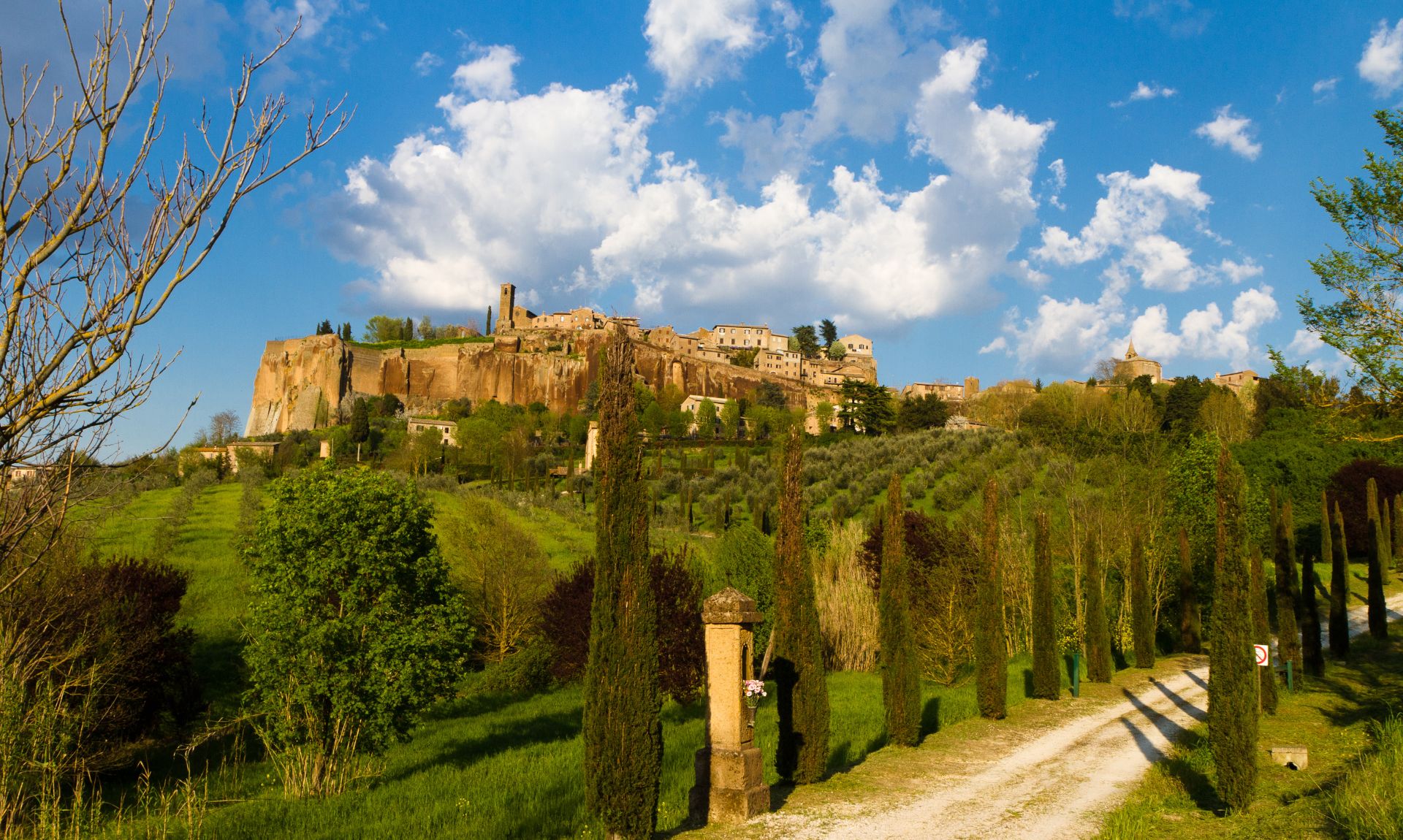
There are cities that let themselves be looked at from a distance and cities that ask to be lived from the inside. Orvieto belongs to the second kind.
Perched on its tufa cliff, visible from the motorway as an ancient silhouette suspended between sky and countryside, Orvieto does not reveal everything at once. You have to climb — by funicular, by car, on foot if you are feeling brave — and then walk. Walk slowly, without hurry, letting the lanes do their work.
A weekend is the minimum time to do it properly. Here is how.
First afternoon: the Duomo and what surrounds it
There is no point in putting it off: the Duomo di Santa Maria Assunta should be seen first, while you still arrive with fresh eyes. The Gothic façade — three centuries of work, more than twenty artists — is one of those things that takes your breath away even if you have seen it before. But it is the interior that surprises most: the Cappella del Corporale and the Cappella di San Brizio hold frescoes by Luca Signorelli that many art historians consider the direct premise of the Sistine Chapel.
The Museo dell’Opera del Duomo, right next door, gathers six centuries of sacred art in an intimate and rarely crowded itinerary.
Use the afternoon to get your bearings: Piazza del Duomo, then Corso Cavour, then Piazza del Popolo. This is the heart of the city, the place where residents pass through, sit down, meet one another. The twice-weekly market — Thursday and Saturday mornings — transforms the square into something even more alive.
Evening: the historic centre without the tourists
After five o’clock, many tour groups leave. It is the best moment to walk. The lanes empty out, the light changes, the tufa stones turn a colour that does not exist in brochures. Stop at the Torre del Moro, a few steps from the centre: its two bells have marked the hours of Orvieto for centuries, and from the top the view over the historic centre is worth the narrow steps.
For dinner, look for a trattoria without a menu in five languages. Orvieto still has a few of the real ones.
Second day: the underground and the cliff
The morning is for Orvieto Underground. Beneath the streets, carved into the tufa, a labyrinth of tunnels, wells and caves opens up — dug over more than 2,500 years of history. It is an experience that overturns your perception of the city: as you walk on the surface, beneath you lies another Orvieto, silent and parallel.
In the afternoon, if the weather allows, walk at least part of the Anello della Rupe: five kilometres around the rock on which the city stands, with views that change at every turn. You do not need to complete the whole route — even half an hour changes the way you look at Orvieto.
Before leaving, it is worth stopping at the Pozzo di San Patrizio. It is the city’s second masterpiece, after the Duomo: 54 metres deep, a double helical staircase that descends and ascends without ever crossing itself. A sixteenth-century feat of engineering that feels conceived today.
Where to stay
The choice of where to sleep changes the entire experience. Orvieto is a small city, but the difference between staying in the historic centre and staying outside is felt — in time saved, in convenience, in the way you experience the evening and the morning.
Hotel Posta is two hundred metres from the Duomo, inside a sixteenth-century noble palazzo. It is not a luxury hotel, and it does not try to be. It is a place to truly stay in the historic centre, with breakfast served in the garden and the possibility of stepping outside in the morning already inside Orvieto.
For a weekend, it is exactly what you need.