

Perched on a dramatic tufa cliff overlooking the valley of the river Paglia and the Umbrian countryside, Orvieto is one of the most captivating towns in central Italy. Its thousand-year history, with roots in the Etruscan age, weaves together medieval traces, Renaissance masterpieces and breathtaking views. To walk its streets is to step into a timeless atmosphere of elegant squares, picturesque alleys and traditions passed down over centuries.
Thanks to its strategic position halfway between Rome and Florence, Orvieto makes an ideal destination for a cultural weekend, a romantic escape or a holiday spent discovering the most authentic side of Umbria. The town offers an extraordinary artistic and architectural heritage, one that surprises first-time visitors and returning travellers alike.
Here at the Hotel Posta we experience it every day and, even now, we keep discovering new corners and unexpected details. In this guide we’d like to share the five places every visitor should truly see.
1. The Duomo of Orvieto
Just steps from our hotel, the Duomo of Orvieto is one of the most beautiful cathedrals in the world. An extraordinary synthesis of architecture, sculpture, decorative arts and painting, it is regarded as a masterpiece of the Italian Romanesque-Gothic style. Construction began in 1290 at the wish of Pope Nicholas IV and continued for around three centuries, involving some of the greatest artists of the age. Its perimeter walls are laid in horizontal bands of white travertine and grey-blue basalt, beneath one of the most spectacular façades in Italy. Of particular interest are the Chapel of San Brizio, decorated with a magnificent fresco cycle on the theme of the Last Judgement, begun by Beato Angelico and completed by Luca Signorelli; and the Chapel of the Corporal, frescoed by Ugolino di Prete Ilario, which houses the blood-stained linen linked to the Miracle of Bolsena.
2. Orvieto Underground
Beneath the streets and palazzi lies a parallel city. This is Orvieto Underground, a labyrinth of caves, quarries and chambers carved out over more than 2,500 years of history. The guided tours, departing from Piazza del Duomo, descend into the heart of the cliff that supports the modern town and reveal how the people of Orvieto made use of these cavities: as food stores and air-raid shelters, as wells and as dovecotes where pigeons were raised — a precious source of sustenance during the many sieges that marked the town’s history (some local restaurants still serve pigeon today). It’s a particularly evocative visit, revealing a lesser-known face of Orvieto made of mystery, ingenuity and remarkable historical traces that often escape those who see only the town’s surface.
3. The Torre del Moro
For those who wish to admire Orvieto from above, the Torre del Moro is an essential stop. Standing 47 metres tall, it rises over the rooftops of the historic centre and marks the crossroads from which the town’s four quarters (Corsica, Serancia, Olmo and Santa Maria della Stella) and some of its most important streets branch out. Dating from the late 13th century, it was originally called the Pope’s Tower — closely tied to the structure of the papal palace — and only took its present name in the 16th century, probably in reference to one Raffaele di Sante, known as “il Moro,” who owned an adjacent building. From its summit, reached by lift for the first half of the climb and by staircase for the rest, the view stretches from the Umbrian countryside to the more distant villages and hills.
4. St. Patrick’s Well
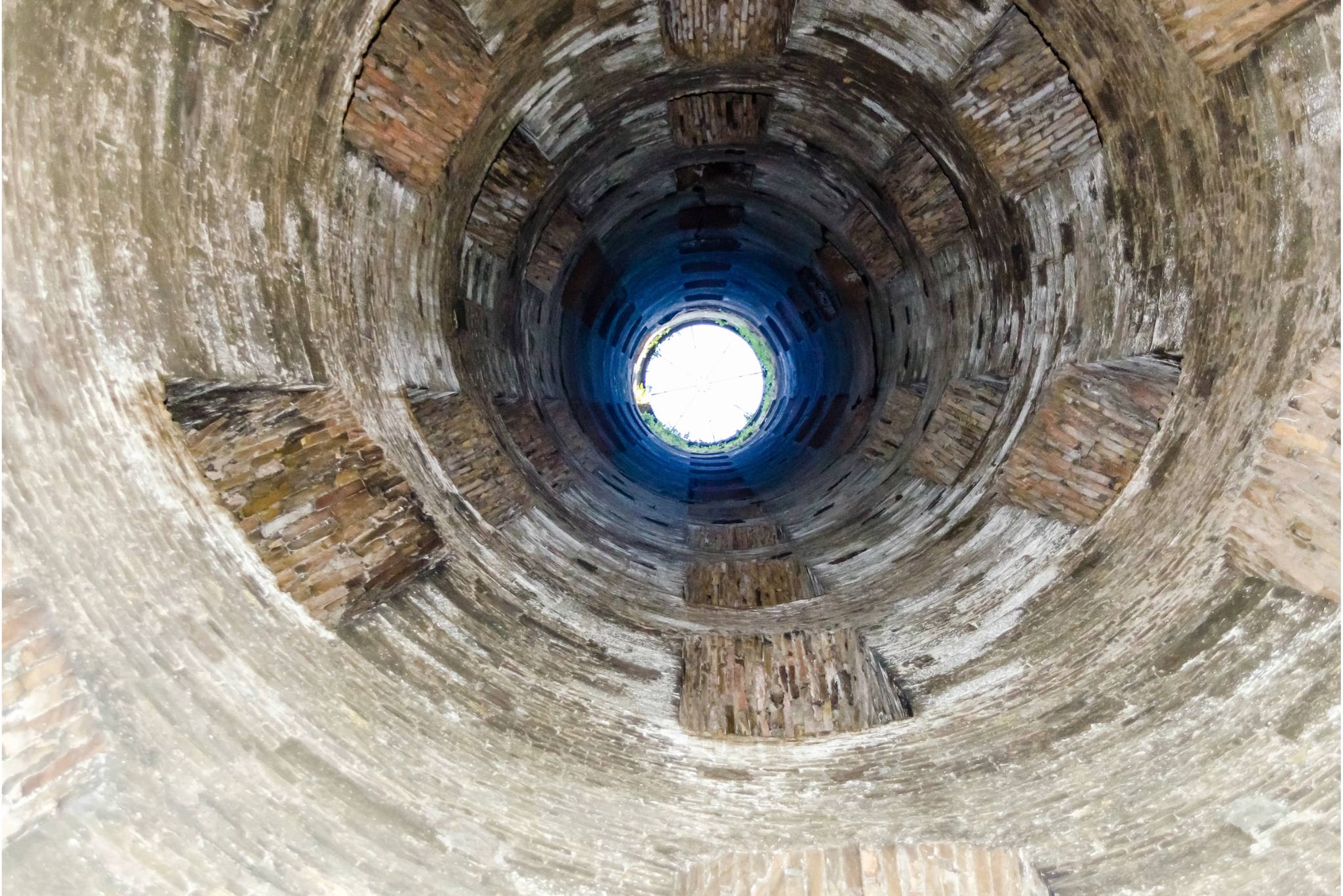
Commissioned by Pope Clement VII to supply water to the townspeople in the event of a siege, St. Patrick’s Well (Pozzo di San Patrizio) is a masterpiece of Renaissance engineering designed by Antonio da Sangallo the Younger, who drew inspiration from the spiral staircase of the Villa del Belvedere in the Vatican. What makes it unique is its extraordinary internal structure. Formed by a great cylinder over 50 metres deep, it has two independent helical ramps (those descending never meet those climbing) with long, low steps designed to allow pack animals to make the climb. The ramps are lit by large single-light windows opening onto the cylinder. Walking its 248 steps, you feel you are entering a place where ingenuity, spirituality and resilience come together in a way found nowhere else.
5. The Albornoz Fortress
In the immediate vicinity of St. Patrick’s Well, on the left-hand side of Piazza Cahen, stands the Albornoz Fortress (or Rocca), yet another legacy of the papal fortifications. It was built by the papal legate, Cardinal Egidio Albornoz, on the orders of Pope Innocent VI and to the design of Ugolino di Montemarte, in 1364. Although only the perimeter walls, three gates and the towers remain of the original fortress, it still shows all the grandeur it must once have had. Today the area is given over to the Public Gardens. From here you can enjoy a fine view over the hills surrounding the town and the valley of the river Paglia. Strolling through the gardens, you can also admire the surrealist bronze sculptures by contemporary American artist Jack Zajac.
And if you have more than a weekend to spare, the surrounding area holds its own surprises: less than an hour away lies the Park of the Monsters in Bomarzo, one of the most unusual places in central Italy.
Living These Places, Just Steps from Where You Sleep
The beauty of Orvieto is that it unfolds on foot. Staying within the town walls means stepping out in the morning and finding yourself before the Duomo within minutes, coming back for an afternoon pause and setting off again without ever touching the car.
This is exactly what the Hotel Posta offers, inside the sixteenth-century Palazzo Guidoni, two hundred metres from the cathedral. It’s the most natural way to choose where to stay in Orvieto: in the heart of the historic centre, with the whole town within walking distance.